
Acerca de

-
Internship at School of Engineering & Applied Science, UNIVERSITY of VIRGINIA
–Charles L. Brown Department of Electrical and Computer Engineering
Internship Period: June '26 - August '26 (online)
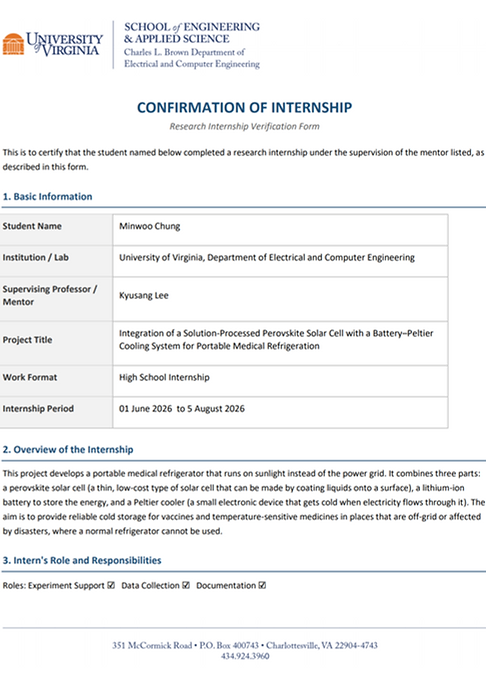
Project Title : Integration of a Solution-Processed Perovskite Solar Cell with a Battery–Peltier Cooling System for Portable Medical Refrigeration

Overview of the Internship
This project develops a portable medical refrigerator that runs on sunlight instead of the power grid. It combines three parts: a perovskite solar cell (a thin, low-cost type of solar cell that can be made by coating liquids onto a surface), a lithium-ion battery to store the energy, and a Peltier cooler (a small electronic device that gets cold when electricity flows through it). The aim is to provide reliable cold storage for vaccines and temperature-sensitive medicines in places that are off-grid or affected by disasters, where a normal refrigerator cannot be used.
Research Background, Objectives and Methods
. Research Background
-
Many medicines, including vaccines, must be kept cold, in the range of 2 to 8 °C, from the factory all the way to the patient. This unbroken chain of refrigeration is called the cold chain, and it is very hard to maintain in regions without reliable electricity. Ordinary silicon solar panels could supply power, but making them requires expensive high-vacuum equipment and processing temperatures above 1,000 °C, so they cannot easily be produced locally in remote areas. Perovskite solar cells (PSCs) are different. They can be made at normal room pressure by simply coating liquid chemicals onto a surface, a method called solution processing. This makes them potentially cheaper and easier to scale up, which is why they are an attractive option for this problem.
-
(Project Objectives)
-
The objective is to build and test a self-contained prototype in which the solar cell we fabricate charges a lithium-ion battery, and that battery then powers a Peltier cooler inside an insulated box. The main question is whether this chain of parts, working together with no wall outlet, can hold the inside of the box within the World Health Organization (WHO) vaccine target range of 2 to 8 °C.
-
(Research Methods)
-
The solar cell was built one layer at a time. The lower layers (the hole transport layer, the perovskite light-absorbing layer, and a protective passivation layer) were deposited by spin-coating, where a drop of liquid is spun very fast so it spreads into an even thin film. The upper layers (the electron transport layer and the metal cathode) were added by vacuum thermal evaporation, where the material is heated in a vacuum until it evaporates and lands on the cell as a thin coating. The finished solar cell was then wired to a charge controller (which safely manages charging), a lithium-ion battery pack, and a 12 W Peltier cooler attached to an aluminum heatsink that carries heat away. The whole system was then tested outdoors in direct sunlight to see how well it could cool.
My Role and Responsibilities
-
Roles: [✓] Experiment Support [✓] Data Collection [✓] Documentation
-
Specific Tasks
-
Helped with the step-by-step thin-film deposition used to build the solar cell, including spin-coating the NiOx and Me-4PACz hole transport layers and the perovskite absorber. Each layer has to be coated in the right order and thickness for the cell to work.
-
Supported the electrical testing of the finished solar cell, helping measure its open-circuit voltage (VOC) and short-circuit current (ISC) under an LED light that stands in for sunlight.
-
Took part in assembling and outdoor-testing the portable cooler, and recorded the temperature inside the box every 10 minutes while it was running so the cooling performance could be tracked over time.
Achievements and Outcomes -
(Quantitative Outcomes)
-
Successfully fabricated a working perovskite solar cell that produced an open-circuit voltage of 0.95 V, a short-circuit current of 84.02 µA, and a fill factor of 48.4% under LED illumination.
-
Recorded outdoor cooling data showing that, after pre-cooling, the system held the inside of the box between 12 and 13 °C for 50 minutes, and slowly rose to 15 °C after 80 minutes.
-
(Qualitative Outcomes)
-
Showed that the solar-cell → battery → Peltier chain can keep actively cooling with no outside power source. This proves the basic idea works for decentralized medical refrigeration, even though the 2 to 8 °C target was not fully reached yet. The gap points clearly to what needs to improve, mainly a larger solar cell and a stronger cooler.
Lessons Learned
-
Research skills: I gained hands-on experience in solar-cell fabrication, including spin-coating and thin-film annealing (heating a film to improve its quality), and in wiring together the circuit that harvests and stores the energy.
-
Self-directed learning: I studied how perovskite solar cells work, how thermoelectric cooling (the Peltier effect) turns electricity into cold, and why keeping the global medical cold chain running is such a difficult logistics problem.
-
Academic curiosity: I became strongly interested in how advanced energy materials can be turned into appropriate technology, meaning practical, low-cost solutions designed for resource-limited settings.
-
Contribution to the research: I helped prove that the full prototype works end to end, and the baseline data I collected shows exactly where future versions need to scale up, such as larger solar-cell arrays and multi-stage Peltier coolers.
-
Career alignment: This experience strengthened my interest in engineering and renewable energy, especially technologies aimed at improving global health and reducing infrastructure inequality
Let’s Work Together
Get in touch so we can start working together. Press <Contact>